
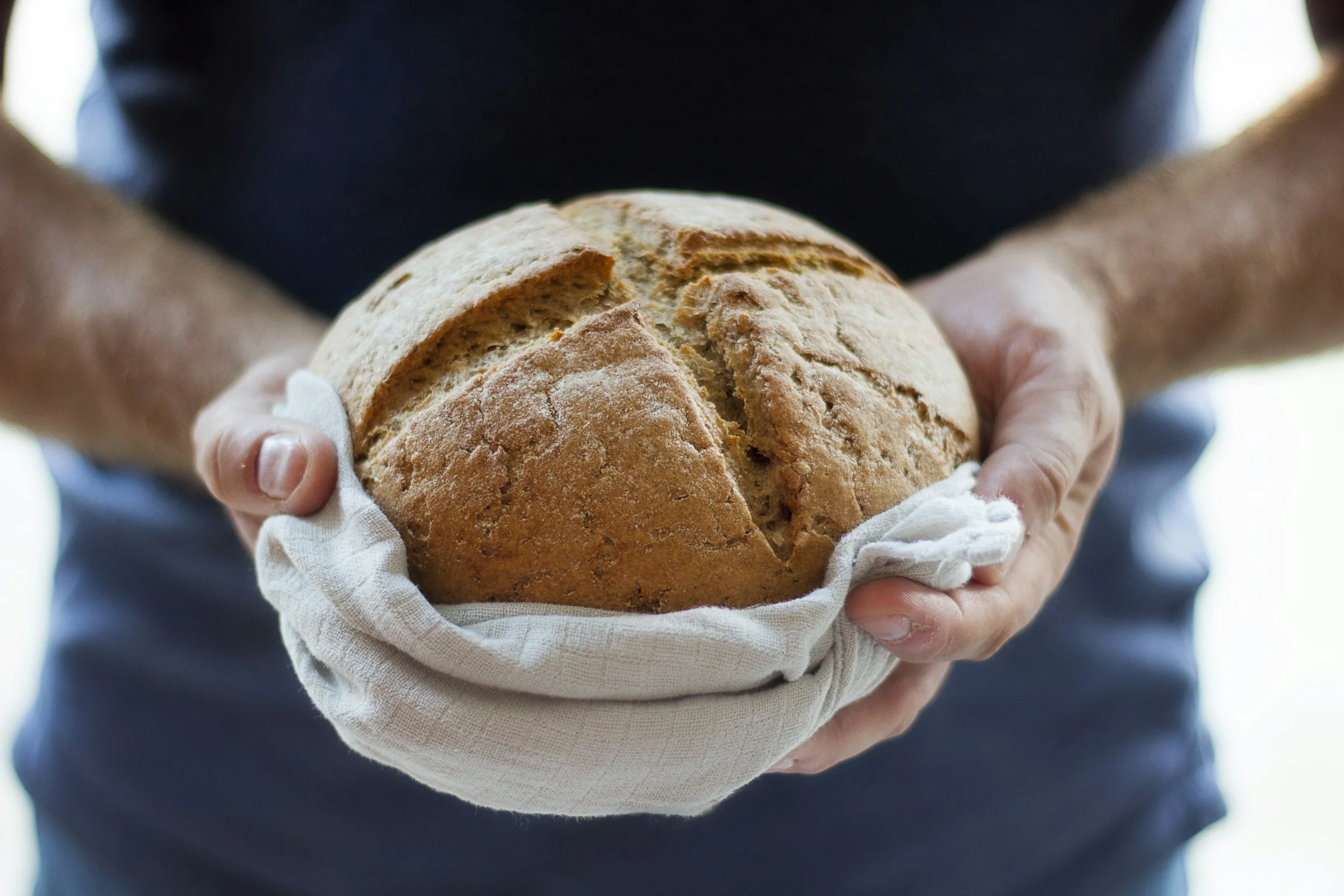
BREAD FROM THE GROUND, BREAD FROM THE GRAVE
A reflection on Luke 24:13–35
Encountering Jesus · Week 1
There is a blessing Jewish families have recited over bread for thousands of years. It goes like this:
“Baruch atah Adonai, Eloheinu melech haolam, hamotzi lechem min ha-aretz.
Blessed are You, O Lord our God, King of the Universe, who brings forth bread from the earth.”
Notice what the blessing does not say. It does not ask God to bless the bread. It blesses God for what He has already done — for the miracle so ordinary we forget it is a miracle at all. Grain goes into the ground. It dies. And from that death, bread comes forth. Every loaf on every table is a resurrection in miniature. The earth gives back what was buried in it.
The two disciples on the road to Emmaus knew this blessing. They had prayed it their whole lives. They just did not know, on the afternoon of the first Easter Sunday, that they were about to watch it become the truest thing they had ever said.
THE ROAD
They were walking away from Jerusalem. That detail matters. Jerusalem was where the hope had been — and where it had died on a Friday afternoon between two criminals. They had believed Jesus was the one who would redeem Israel. Past tense. We had hoped. The verb had already changed tenses before they opened their mouths to say it.
A stranger fell into step beside them. They didn’t recognize Him. Grief does that — it narrows the world until you can only see the shape of what you’ve lost. He asked what they were talking about, and they stopped walking. Luke says they stood still, looking sad. That is one of the most honest sentences in the New Testament. Sometimes grief stops your feet before it stops your mouth.
They told Him everything. The crucifixion. The empty tomb. The women’s report that He was alive — which they did not believe, because the apostles had gone to see for themselves and found nothing but folded linen. The stranger listened. Then He called them foolish — not cruelly, but the way a teacher speaks to students who have the text in front of them and still cannot see what it says.
And then He opened the Scripture to them. Beginning with Moses. Working through all the prophets. Showing them, passage by passage, that everything they thought had disqualified Jesus as Messiah had actually been announced in advance. The suffering was not a contradiction of the prophecies. It was the fulfillment of them. By the time they reached Emmaus, seven miles later, something had shifted in them that they could not yet name.
THE TABLE
They asked Him to stay. Evening was coming. He came inside and sat down at their table — and here the story turns on a detail most modern readers walk right past.
In first-century Jewish practice, the host of a meal recites the blessing over the bread. But there was a second tradition: if a sopher — a recognized Torah scholar — was present, the host would defer to him. After spending seven miles listening to the most extraordinary exposition of Hebrew Scripture they had ever heard, Cleopas and his companion recognized a sopher when they heard one. So they handed Jesus the bread. They gave Him the host’s place.
He took it. He lifted it. He said the blessing.
Baruch atah Adonai, Eloheinu melech haolam, hamotzi lechem min ha-aretz.
Blessed are You, O Lord our God, King of the Universe, who brings forth bread from the earth.
He broke it. He gave it to them. And their eyes were opened.
WHAT THEY SUDDENLY UNDERSTOOD
Think about what they heard when He said those words.
Who brings forth bread from the earth. The God who reaches into the ground and raises up what was buried there. The God whose economy runs on death that becomes life, on seeds that fall and rise, on grain that goes down and comes back. The God who has been telling this story since the first harvest — in every loaf of bread, on every table, in every home, in every prayer.
And here, standing at their table with bread in His hands, was the man who had been in the ground three days and come back out of it.
The blessing had always been true. They had just never had the referent for it. Every time they had prayed hamotzi — who brings forth from the earth — they had been confessing a God whose deepest nature was resurrection. And now the Resurrection Himself was standing at their table, saying the words, handing them the bread.
No wonder their eyes opened. The whole Scripture had just collapsed into a single moment at a dinner table in Emmaus. And then He vanished.
THE BURNING
They sat there in the silence He left behind. And one of them said it quietly, the way you say something you’re still not sure you believe:
““Did not our hearts burn within us while he talked to us on the road, while he opened to us the Scriptures?” — Luke 24:32”
That is the question that has echoed through Christian history ever since. Not did we understand? Not did we agree? Did our hearts burn?
The burning did not come from the table. It came from the road — from the opened Scripture, from the Word of God rightly handled, from the moment when Moses and the prophets and the psalms all suddenly pointed the same direction. The table confirmed what the Word had already ignited. The bread in His hands sealed what the Scripture in His mouth had already begun.
They got up that same hour and walked back to Jerusalem in the dark. Seven miles. The same road. But they were not the same people who had walked it six hours earlier. The verb had changed tenses again. We had hoped had become we have seen.
FOR US
Every time the Scriptures are opened rightly — with Christ at the center, with the whole Bible understood as a Christ-shaped space — the same thing that happened on the Emmaus road is available to us. Not as a memory. As a promise.
The God who brings forth bread from the earth is the God who brought His Son from the grave. The blessing has always been true. We are still learning what it means.
Come to the table. Let Him break the bread. And don’t be surprised if something in you catches fire on the road before you get there.
You’ve read the post - now watch the sermon